Posted 1 week ago

Still have questions?
If you have any questions, feel free to contact us at support@stratis.com. A member of our support team will help you shortly.
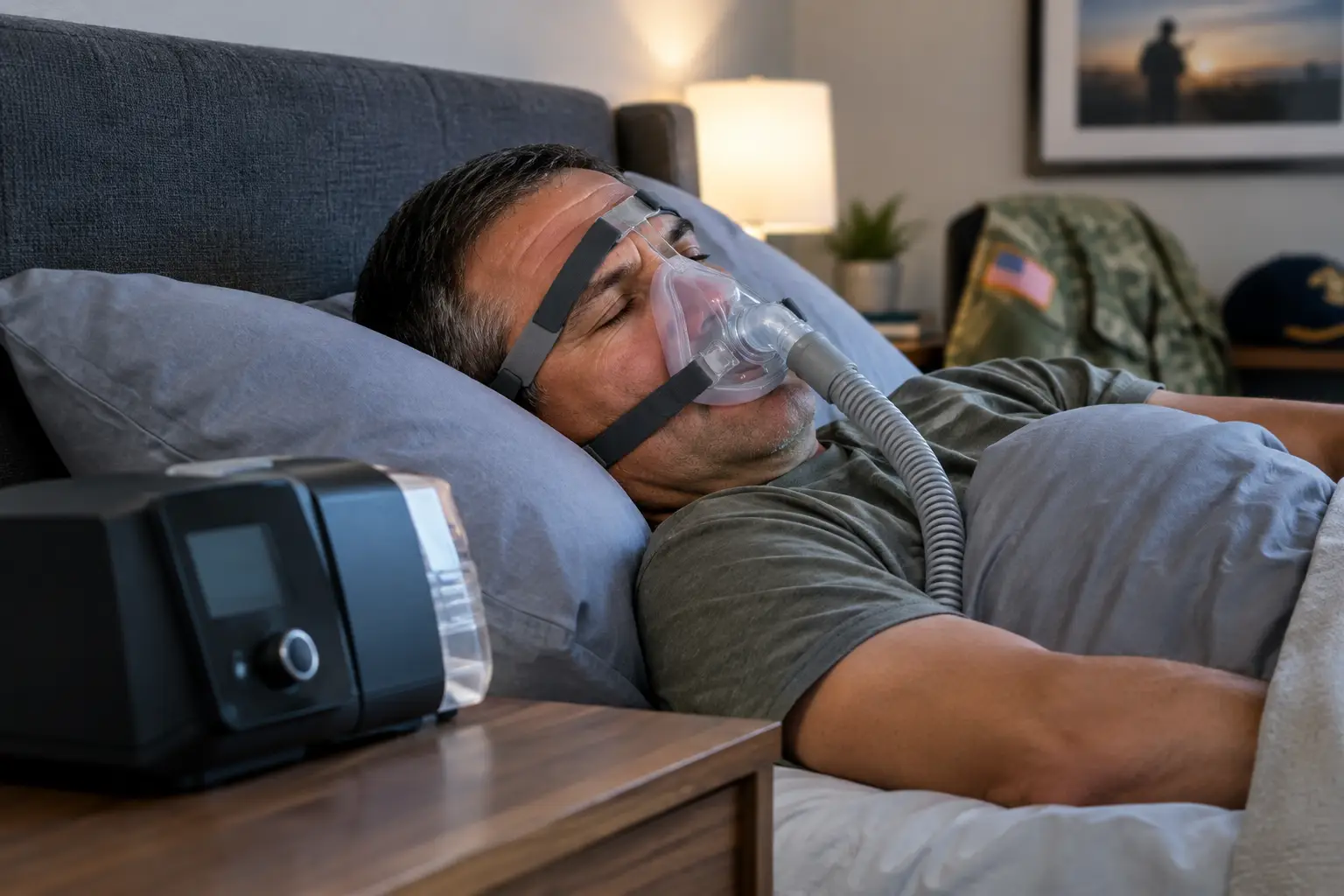
A positive sleep study can confirm obstructive sleep apnea. It does not, by itself, explain why the condition should be service connected. That gap is where many otherwise legitimate claims fall apart. This sleep apnea example shows the difference between having a diagnosis and having a medically defensible VA claim.
Obstructive sleep apnea claims are often treated like a checkbox exercise: get diagnosed, mention snoring, submit the claim. That is not how medical reasoning works, and it is not how the VA is supposed to evaluate service connection. The real question is whether the available evidence supports a connection between the veteran’s sleep apnea and military service, another service-connected condition, or aggravation by a service-connected condition.
A Sleep Apnea Example: Diagnosis Is Only the Starting Point
Consider a fictional veteran who served on active duty for eight years. During the final two years of service, his spouse noticed loud snoring, choking sounds during sleep, and repeated pauses in breathing. He was constantly tired during the day, fell asleep easily when sitting still, and had morning headaches. Like plenty of service members, he did not schedule a sleep clinic appointment while juggling duty requirements, field time, and family life.
Eighteen months after separation, he completed a sleep study and was diagnosed with obstructive sleep apnea. He now uses a prescribed breathing device. His service treatment records do not contain a sleep apnea diagnosis because no sleep study was performed while he was in uniform.
On those facts alone, the claim is not automatically strong or weak. It depends on what evidence fills the gap between service and the post-service diagnosis.
The veteran may have useful evidence in a spouse statement describing what she personally observed during service. A former roommate, bunkmate, or fellow service member may be able to describe loud snoring, gasping, witnessed breathing pauses, or unusual daytime sleepiness. The veteran’s own statement can explain when symptoms began, how often they occurred, and why he did not seek care at the time.
Those statements do not replace a medical diagnosis. They can, however, establish that observable symptoms consistent with sleep-disordered breathing were present before the formal diagnosis. A clinician reviewing the file would then need to address whether those reported symptoms, the timing of diagnosis, the veteran’s medical history, and other risk factors support a connection to service.
That is a claim theory. It is not a guarantee. The quality of the medical opinion matters because sleep apnea has multiple risk factors, and a competent opinion needs to deal with the unfavorable facts instead of pretending they do not exist.
What Makes the Evidence Stronger or Weaker
In this example, evidence becomes stronger when the timeline is consistent. Symptoms during service, a diagnosis relatively soon after separation, and credible lay observations can create a medically coherent story. Records showing complaints of fatigue, poor sleep, headaches, weight changes, nasal symptoms, or daytime somnolence may also be relevant, depending on the facts. They are not proof by themselves, but they may support the overall clinical picture.
Evidence becomes weaker when the history changes repeatedly or when the record shows a long unexplained gap with no reported symptoms. That does not mean the claim must fail. It means the medical explanation has more work to do.
A useful medical review should also identify other relevant factors, such as body habitus, age, alcohol use, anatomy, chronic nasal obstruction, medication history where documented, and post-service weight changes. Ignoring these issues is not advocacy. It is just bad medicine, and the VA may notice.
A strong opinion does not need to claim that every snorer has sleep apnea. Plenty of people snore without obstructive sleep apnea. Instead, it should explain why the particular facts in the veteran’s record make a service connection medically plausible and supportable, or why they do not.
The Difference Between Symptoms and a Diagnosis
Veterans sometimes get hung up on the lack of an in-service sleep study. A sleep study is the standard method for diagnosing obstructive sleep apnea, so its absence during service may be a problem. But it is not always fatal to a claim.
The relevant question is whether there is credible evidence of symptoms during service that a qualified clinician can reasonably relate to the later diagnosis. Witnessed pauses in breathing, gasping awake, excessive daytime sleepiness, and persistent loud snoring may carry more weight than a vague statement that someone “slept badly.” Specific, firsthand observations are generally more useful than a generic buddy letter written years later with no detail.
The record should tell one consistent story. If the veteran says symptoms began in service, but earlier medical records repeatedly document that symptoms began many years later, that conflict needs to be addressed honestly. Trying to paper over contradictions is how a potentially supportable claim becomes less credible.
How a Secondary Sleep Apnea Theory May Look
Not every sleep apnea claim is based on direct service connection. Some veterans explore whether sleep apnea is secondary to an already service-connected condition. This area requires particular care because the internet has created a lot of bad advice.
A service-connected condition does not automatically cause obstructive sleep apnea. PTSD does not automatically cause it. Sinusitis, rhinitis, tinnitus, orthopedic pain, and mental health conditions do not automatically cause it either. A diagnosis list is not a nexus.
A secondary theory needs a specific medical explanation supported by the veteran’s actual records. For example, a veteran may have service-connected orthopedic conditions that substantially limited activity over time, documented weight gain, and a later sleep apnea diagnosis. In some cases, obesity may be medically relevant as an intermediate step in the analysis. But that theory requires careful documentation and clinical reasoning about the veteran’s functional limitations, weight history, other contributing factors, and whether the claimed relationship is medically supported.
Likewise, chronic nasal conditions may be relevant in certain cases, but they are not a shortcut. The medical evidence must explain the mechanism and account for the full record. A generic letter stating that one condition “can cause” another is usually not enough. “Can” is not the same as showing what is at least as likely as not in one veteran’s case.
What a Records-Based Review Should Examine
Before paying for a nexus letter or submitting a theory that sounds good on social media, review the foundation. The key evidence often includes service treatment records, entrance and separation examinations, post-service primary care notes, sleep medicine records, diagnostic sleep study results, medication and problem lists, prior VA decisions, C&P examination reports, and relevant lay statements.
The goal is to identify both favorable and unfavorable evidence. Favorable evidence might include a consistent history of in-service symptoms and a prompt post-service diagnosis. Unfavorable evidence might include records showing symptoms started well after service, significant non-service-related risk factors, or prior statements that conflict with the current claim.
A credible medical opinion should discuss both. An opinion that only repeats favorable facts may look more like a purchased conclusion than an actual clinical analysis. That is not helpful to the veteran.
Patriot Advisors approaches these cases by looking at the records first, then assessing whether there is a medically supportable path forward. Sometimes that means a well-reasoned nexus opinion may be appropriate. Sometimes the record needs better lay evidence, clarification of the timeline, or additional medical documentation. And sometimes the honest answer is that the available evidence does not support the theory being considered.
The Practical Lesson From This Sleep Apnea Example
The best sleep apnea claims are built around facts, not slogans. Start with the diagnosis, then build the timeline. Identify what was observed during service, what the medical records show after service, and what a qualified clinician can reasonably conclude after considering all relevant risk factors.
If the evidence supports a direct or secondary path, document that path clearly. If it does not, do not force it with a generic template letter and a lot of wishful thinking. A clean, evidence-based strategy gives a veteran a far better starting point than chasing the claim theory that happens to be popular this month.